

The importance of Story Points
This post goes back to the beginning. In today’s world, where many companies are talking about AI tools and seeking to implement AI everywhere, I’ve noticed that something important is still missing.
Most teams still struggle with basic project planning practices. What do I mean by this? Quite simply, teams often lack a clear methodology for planning their work. They create plans without looking at real data or past estimates (which often they don’t have that kind of data). They just keep adding more and more User Stories to Backlog, without a clear strategy.
You can probably guess what happens next: teams run around doing lots of work, but going ultimately nowhere. They build up technical debt. Sooner or later, this hurts the product quality and value for customers.
So here’s the problem: everyone is rushing toward AI, but they are forgetting that the basics still matter. Even AI tools won’t help if your basic planning process is broken.
Think of it like running: You can’t just wake up one day and run 42 kilometres without proper preparation. Same with AI tools. Even the most amazing AI tools won’t fix bad processes for us – if we haven’t established solid foundations in planning and estimation.
That’s why I want to explain story points one more time – in the clearest way possible. I’ll briefly explain why they can be important, how they can help teams plan better, and how they improve teamwork.
Let’s start with the fundamentals.
What are Story Points are and How to Use Them
In every project, teams face uncertainty: users’ stories, tasks can be more complex than they appear, estimates can be inaccurate, and unexpected risks can have an impact on timelines. These challenges make planning and delivery a constant struggle.
Story points turn subjective guesses into objective, consistent measures, providing projects with clarity, predictability, and a higher likelihood of on-time delivery.
Story points are one of the most misunderstood and misused terms in Agile methodologies. People forgot that a story’s points should reflect relative estimation, experience, and knowledge rather than absolute time.
The Golden Rule: Story points are NOT a measure of hours or time required to complete a User Story. One story point does not equal one day.
The Three Pillars of Story Points
To get an idea of how long something will take, a team should not just think about the time it takes.
Instead, they should carefully examine the user story and consider three key factors:
- Complexity: How difficult is the task to solve? Does it require high-level logic or a simple update?
- Effort (Volume): How much work is actually involved? A simple task (low complexity) might still take a long time if there is a high volume of data to process.
- Risk and Uncertainty: Are there things we do not know about? Do we have the permissions, or can we use the Application Programming Interface? When the risk is high, the story point value is usually higher because we have to think about the delays, with the Risk and Uncertainty.
Let’s illustrate this with an example:
Imagine two developers : one senior and one junior – both need to comparing a User Story from the Backlog.
- The Senior Developer might estimate that the task will take 1 day.
- The Junior Developer might estimate that the same task will take 2 days.
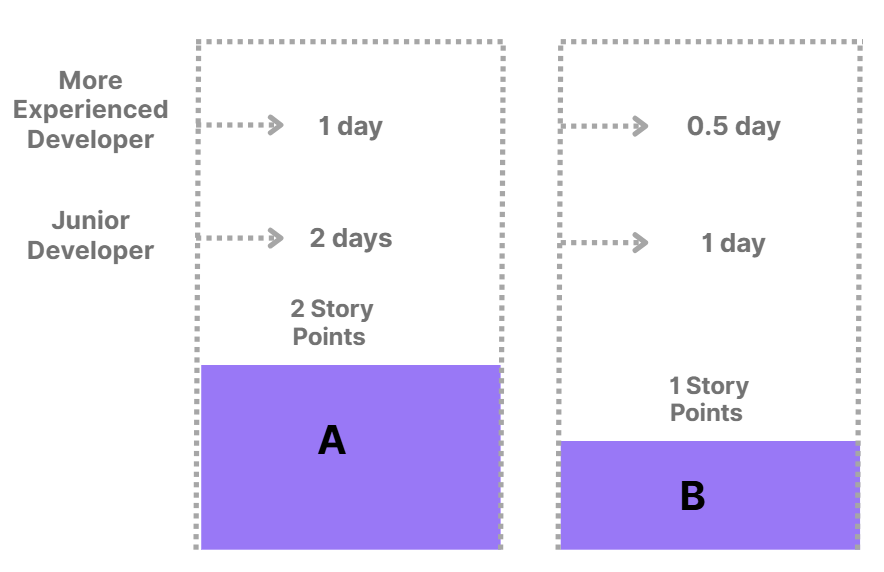
If we estimated purely in time, the same task would have two different numbers. However, the complexity of the task hasn’t changed. By using Story Points, both developers can agree that the task is, for example, a “3-point story” based on its difficulty, risk, and effort. This approach allows the team to plan based on the total amount of work they can complete, regardless of who does it.
Updating Story Points – When Things Change
One important thing teams often forget: story points should be updated regularly. Change is constant in project management. Is the same with Story Points. When new requirements or information appear, technical challenges emerge – your estimates should be revisited. Story points are not “set in stone”; they should evolve as understanding improves. Ignoring this leads to unrealistic plans and frustrated teams.
Re – estimating is not a failure, its a good practice. It helping teams:
- Keep plans realistic
- Learn from previous assumptions
- Improve future forecasting
Because the foundation of Agile planning is adaptation, not sticking to an outdated estimate.
How to Record Your Estimates
Once the team has agreed on a point value, it should be recorded in your project management tool ( Azure DevOps, Jira (for Teams):
Azure DevOps
Adding Story Points to the Azure DevOps Board.
Jira ( for Teams)
Adding Story Points to Jira.
AI and estimation
Many companies try to apply AI everywhere, but story point estimation is one area where it is better not to rely on AI.
Of course, AI can be a valuable – but it needs to be used wisely. When it comes to story points, AI should not replace people. Estimation is a human, team-based activity. Generative AI does not truly understand a team’s real capabilities. Yes, AI generated numbers can look “smart”, but this is not what we should expect from a good estimation. You don’t need false confidence for product owners and management. Automating story points doesn’t remove uncertainty; it often just hides it.
So, how can AI be used effectively in estimation?
AI can support the estimation process without taking control of it by suggesting an initial range of story points based on historical patterns (if they exist), and then the team can discuss and adjust during refinement or planning.
Using an AI extension in Azure DevOps Board or in Jira in the right way can help highlight trends where the team has consistently over- or under-estimated, and also can support continuous improvement. Surface risks or anomalies by comparing new stories with similar past work. In this way, AI acts as an assistant, improving the quality of the conversation – while humans remain responsible for the final story point decisions.
Summary:
Story Points can help teams estimate work based on complexity, effort, and uncertainty, rather than individual speed or assumptions. When used correctly, story points create realistic plans, improve predictability, and encourage conversations within the team.
AI can support this process by highlighting patterns and risks, but can’t replace human judgment, team experience – story points work because teams are accountable for them, not because numbers exist in a tool. Strong fundamentals in estimation should come first – only then modern tools (including AI) can add true value.
About author

You might also like

Protected: Motorhome Trip
There is no excerpt because this is a protected post.

Last week reading (2018-04-15)
Good day SQL folks! Spring is everywhere all around us! You might not necessarily see this Monday morning at work… I hope you will have an easy start of the


Stellar Repair for MS SQL – Product Review
If you’re experiencing delays and errors while working with SQL Server databases due to corrupt database files, you may feel frustrated and helpless. Fortunately, Stellar Repair for MS SQL offers




2 Comments
Dew Drop – January 19, 2026 (#4585) – Morning Dew by Alvin Ashcraft
January 19, 14:16[…] The importance of Story Points (Paulina Nowinska) […]
dennis
January 20, 00:22This is a clear explanation of why story points matter in planning and collaboration. It highlights how shared understanding improves teamwork and outcomes.