
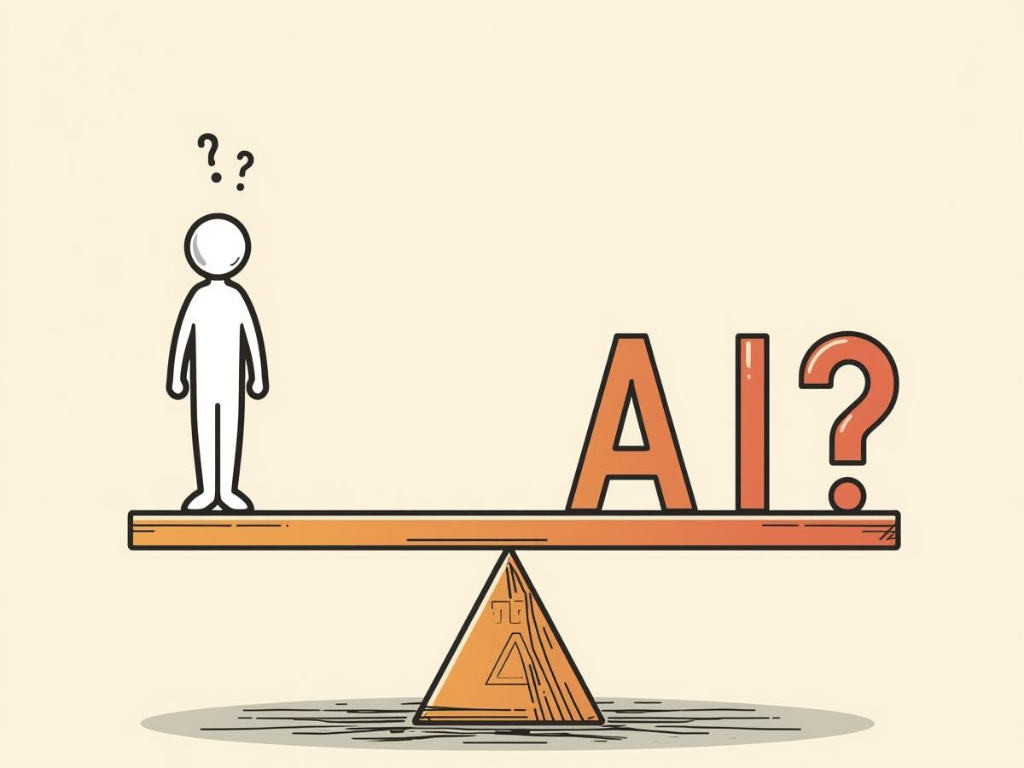
Humans and AI: How to find the right balance
When companies decide to implement AI tools, the main argument is usually that AI will act as an employee assistant – helping people work faster and better.
On paper, it sounds like a perfect strategy. But in reality, this is often a first impression. Reason? Many companies don’t have their own AI strategy – they just copy ideas from popular sources. That makes AI implementations risky. Every company is a unique setup, and a one-size-fits-all approach usually skips over specific processes, the company culture, and what customers really need.
Support, don’t Swap☝
If leaders want to implement AI as a helpful solution for employees, they first need to understand where human and AI can work together – and where AI can’t help.
Let’s be clear on this point: AI is not required everywhere. The smartest AI strategy focuses on knowing where it truly adds value.
AI, of course, can handle repetitive and manual tasks really well. It can save employees hours, allowing them to focus on more complex, creative, problem-solving work. But still, even for automation, this fancy technology is not always the answer. Cheaper, simpler, existing solutions (email filters, calendar rules, or spreadsheet macros) often get the job done without needing fancy AI at all.
Ethics and Responsibility ✅
Leaders should also ensure that this technology fits with ethics, responsibility, and company values. As we all know, AI has no moral compass. In areas like healthcare or finance, a human loop is crucial.
For example, AI can analyse credit applications, highlight budget concerns, or shortlist job candidates, but humans must make the final call. You wouldn’t let AI approve a loan, sign a budget, or hire someone on its own.
Partnership ⚖️
To collaborate effectively with AI, employees need ongoing training. They should learn how to use AI as a partner, not a competitor. Upskilling makes integration smoother, more effective, and ultimately unlocks the full potential of human-AI collaboration.
To do this effectively, organisations should regularly review AI-human collaborations:
– How is this work?
– Are the outputs accurate?
– Checking if there are any blind spots in ethics.
Building a culture where AI is treated like an employee assistant, not a team replacement, will help people see this technology as a collaboration, not a competition.
About author

You might also like

The next crucial step in my career
It’s Wednesday, 31st of July 2019. I will remember this day for a few reasons. Not only that but the last 18 months I spent working with amazing people, in
Stellar Repair for MS SQL – Product Review
If you’re experiencing delays and errors while working with SQL Server databases due to corrupt database files, you may feel frustrated and helpless. Fortunately, Stellar Repair for MS SQL offers

Before Building Your AI Solution: Start with the RIGHT Problem
According to a RAND report, private sector investment in AI grew 18 times more between 2013 and 2024, and over half of mid-sized companies have already deployed at least one




1 Comment
Dew Drop – December 15, 2025 (#4561) – Morning Dew by Alvin Ashcraft
December 15, 12:32[…] Humans and AI: How to find the right balance (Paulina Nowinska) […]